By GREG KING
The edgy, tense and suspenseful thriller Wish You Were Here is an impressive debut feature from Kieran Darcy-Smith, a Sydney-based actor and short filmmaker who is part of the filmmaking collective known as Blue Tongue, which includes siblings Nash and Joel Edgerton. Their films include David Michod’s award winning Animal Kingdom and the tough noir like crime thriller The Square. This domestic drama about the fallout from an overseas holiday was co-written with Darcy-Smith’s wife, actress Felicity Price, who spoke to me about the creative journey behind the film.
Price trained at the Victorian College of the Arts, and has done a lot of theatre and tv work, having appeared in a recurring role on popular soap Home And Away, and some film work. But she has always been writing. “As an actor, I kind of felt that my overactive brain always wanted to have some sort of project that I was creatively involved in,” she says. “And not having a project to be creatively involved in was more destructive and not productive, so I’ve always been writing. This is my first produced screenplay, but there’s a number in drawers.”
Price wanted to write a film that was achievable on a low budget, but she also wanted to draw upon her own experiences and observations. “I was also interested in writing a film about my own demographic – the people I know who were my friends, many of whom were having young children at the time. I was watching them forge a new kind of parenthood I guess. They were not like my own parents or the kinds of parents I saw while growing up. They were toying more with irresponsibility in a way. They were kind of going out partying and having a good time, but at the same time being wonderful parents, and I was interested in that kind of world.”
Price had also heard a story about two couples who went travelling to South East Asia and one of the men had gone missing, and was never found. She was interested in exploring how people cope with the disappearance of someone, that gap left by someone when they disappear, and the traumatic experience it would be for the people who were on that trip, to his family and his friends left behind at home. She put all of those ideas together in one big melting pot, and that’s where the idea for the film began. And the heart of the film is an exploration of how secrets and lies and guilt tear relationships apart.
And when she showed the idea to Darcy-Smith he encouraged her to develop a treatment. “He said: ‘I think we should co-write together.’ He’s a great writer so that was really a great opportunity for me to team up with him,” Price elaborates. “With collaborations you don’t necessarily know how they’re going to turn out, but for us it was really very productive. And we lived together so we didn’t have to make an appointment to see each other to discuss something. We discussed things as we cleaned up the house, or as we were just hanging out on the back step of the apartment, or just walking down to the beach, or whatever. We would constantly be talking about this project, and it became our vocation and all consuming. And two of our own children were born during the process of writing the film. It became something that we really poured all of our lives into. And I think you can see that on the screen.”
In Wish You Were Here Alice (Price) and Dave (Joel Edgerton) are a happily married couple who go on a holiday to Cambodia with her sister Steph (Teresa Palmer) and boyfriend Jeremy (New Zealand actor Antony Starr). But as the holiday winds down, Jeremy goes missing under mysterious circumstances. Steph stays behind to help in the search, while Dave and Alice return home to their two young children. But Dave knows more about what happened than he is telling, and this guilty secret adds tension to his relationship with the pregnant Alice. The film unfolds in a series of lengthy flashbacks that move between Cambodia and present day Sydney, which are laden with an increasing sense of doom and paranoia as it moves towards its powerful climax.
Price and Darcy-Smith spent 12 days in Cambodia, ten of which were actually spent on shooting. “It was insane!” recalls Price of the frantic shooting schedule. “At that stage I had a seven month old baby and a two and a half year old boy. We took the kids, with a nanny of course, as Kieran and I were both heavily involved in the film. And that was another reason it was just total chaos. But we got there and it was kind of exhilarating and challenging in the extreme.”
Price, Darcy-Smith and many members of the crew got very ill, due to the enormous pressures of the shooting schedule. They virtually we hit the ground running. After getting off the plane, they had a couple of hours of sleep. The next morning they were up and out and shooting all day around Phnom Penh, riding on mopeds, scooters, going through markets, eating at night markets, having tarantulas crawl up their arms, watching someone cook a snake. Then they drove to Sihanoukville in the south, and shot quite a lot there. It was an extremely challenging shoot, says Price. “But you can achieve some incredible things in Cambodia that would be much more expensive if you were shooting in Australia,” she adds.
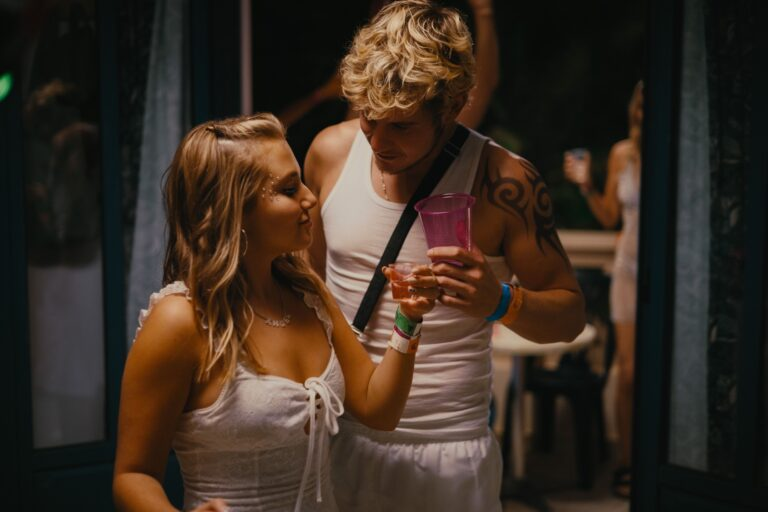
Price recalls one particular night, when they had a full moon party to shoot some crucial scenes. Darcy-Smith and the producer had found a stretch of beach that had a bar on it. They organised to put a $500 tab on the bar, sent out some flyers, and got some people around to have a big party. The place was packed with people drinking. There was even a DJ on a bamboo deck that had been set up for him, and there was a bonfire and there were fire twirlers. And people were genuinely having a good time, continues Price. “And here I was thinking if we did this on St Kilda Beach or Bondi Beach, that would have cost an insane amount! But all that stuff was achievable in Cambodia.”
The choice of title for the film has a nice irony. But it was deliberate choice, admits Price. “We had been interested in trying to find a title that had a kind of pop cultural reference, one of those titles that’s kind of got a reference in your life, you’ve heard it before. We thought the phrase wish you were here had a lot of resonance across the board. Obviously there’s the Pink Floyd song, and it’s also something that you write on the bottom of a post card. The beginning of the film is that fantastic montage where they’re travelling throughout Cambodia, and ‘Wish you were here’ has a kind of positive resonance to it. At the beginning of the film, it’s like: ‘Yeah, we’re all on holidays, wish you could be here!’ But as the film opens it gets a kind of different, ironic feeling. There’s a guy who’s gone missing, and there’s the couple who is not really communicating anymore. I guess there’s the irony of the holiday that has gone terribly wrong.”
Price says that she didn’t write any of the roles with particular actors in mind. But Edgerton is a close family friend – he is even the godfather of Price’s first-born child – and was across the script from the first draft. “He had probably read every single draft of the film from the first draft,” she says. “Not as an actor necessarily, but as someone who is a trusted friend, and someone who gives fantastic feedback, and who is also a writer himself. But when it came to that role itself, Kieran didn’t want to impose on that friendship necessarily by asking Joel to play that role in a low budget Australian film. Because at that point his star was really rising and he was being offered a lot of bigger budget American work. But Joel really loved the script and he knew the project pretty well.”
Darcy-Smith met Teresa Palmer (I Am Number Four, etc) at a dinner party and instantly recognised that she had a particular quality that suited the character of Steph, Alice’s sister in the film. Steph doesn’t have an enormous amount of screen time so Palmer had to tell a story quite quickly to the audience. New Zealand actor Antony Starr (from tv series Outrageous Fortune, etc) read for the role and was just amazing, the perfect fit for the character.
Wish You Were Here had its world premiere at the Sundance Film Festival, which Price excitedly admits is a big deal for a low budget Australian film. Price is pleased at the positive response the film received at Sundance. “It had quite a bit of heat around it, quite a lot of expectation, which was a little nerve-racking for us when we were sitting in the audience watching it. People just loved it, and discussed it in a really serious way. There’s a lot to discuss, a lot of complexities in the film – there’s emotional complexity, and it’s a film that really keeps people thinking and there were challenges for people and people wanted to discuss what happened. I had people coming up to me on the street all the time I was there. These were people who had come to watch cinema, they weren’t part of the industry, they were cinemagoers at the festival, and they just wanted to sit and discuss it. And that was something that we had always aspired to when we were writing the film, to create a piece of work that was worthy of having a dinner party discussion about.
.”It really raised the profile in the US,” she says, “so we have a North American distribution now and a theatrical release in the US, which is a big deal for the success of the film. And I think that opening at one of those major international festivals focuses Australian audiences on the film. For whatever reason it is a really good thing for an Australian film to have international recognition before they open in Australia because it brings people into the cinema. Let’s hope it works that way for our film.”
Wish You Were Here is currently screening in cinemas across Australia.